On her first day at the manufacturing training unit, Vasanthi held a note-book close to her chest. Not loosely. Not casually. She pressed it against herself as though it were both shield and strength. On the cover was the familiar face of Dr. A.P.J. Abdul Kalam — the man who spoke of Wings of Fire.
I remember pausing for a second. The image felt almost cinematic. A woman who had folded away her own wings for fifteen years, now standing before machines that could help her unfold them again.
This is Vasanthi.
She completed her 12th standard like many young girls do — dutifully, without fanfare. She took up a job at a local driving school soon after. It wasn’t glamorous, but it was hers. She earned. She stepped out.
Then she got married. Young.
She moved into her husband’s family home. The job paused. Then stopped. Life rearranged itself around new responsibilities. Meals to cook. Floors to sweep. Relatives to host. A bed-ridden mother-in-law to care for. Children arrived — blessings that also ensured she stayed firmly anchored within the walls of home.
Years passed quietly.
Fifteen of them.
Her children are now in their teens. They manage their own school bags and moods. Her mother-in-law is no more. A co-sister now shares responsibilities at home. For the first time in a long time, there is space. Time that is not immediately claimed.
And in that space, a thought grew.
Can I work again?
Can I earn for myself — at least now?
Can I stand on my own feet once more?
That is how she came to Danirasa Foundation — as the lead admin staff at their newly commissioned training cum manufacturing training unit. A unit that will train and employ women like her to produce essentials used in religious rituals — camphor, wicks, incense, paper plates.
On paper, it sounds simple.
In reality, it is transformative.
The training floor was buzzing. Machines stood tall and unfamiliar — the camphor unit, the wick rolling station, the incense line, the paper-plate press. Each had a trainer assigned. Each trainer, a man.
Vasanthi stood at the centre of this mechanical orchestra, and you could read her nervousness without needing subtitles. She listened to instructions coming at her from every direction. Buttons. Switches. Pressure gauges. Timing. Safety. Output.
For someone who hasn’t worked outside the home for over a decade, this is not just training. It is sensory overload.
Yet she did not retreat.
She moved from one station to another, notebook open, questions ready. When the explanations came too fast, she asked again. When a step seemed unclear, she repeated it aloud to ensure she had understood. At the end of the session, she told each trainer calmly, “If I have doubts tomorrow, I will call you.”
It was not a request. It was a statement of intent.
Every trainer agreed. And every one of them encouraged her.
There was something quietly beautiful about that sight — men teaching, not patronising; a woman learning, not shrinking.
By the end of the day, Vasanthi had been “downloaded” with information from every corner of that unit. It would overwhelm anyone. Yet she sat through it all, absorbing, processing.
Before she left, she asked us something almost shyly.
“Will there be computer work also? I am not very good with computers.”
We asked her one question.
“Do you know how to switch it on and off?”
She nodded.
“Then we will teach you the rest.”
That was it.
Sometimes empowerment does not require grand speeches. Just reassurance that learning is allowed.
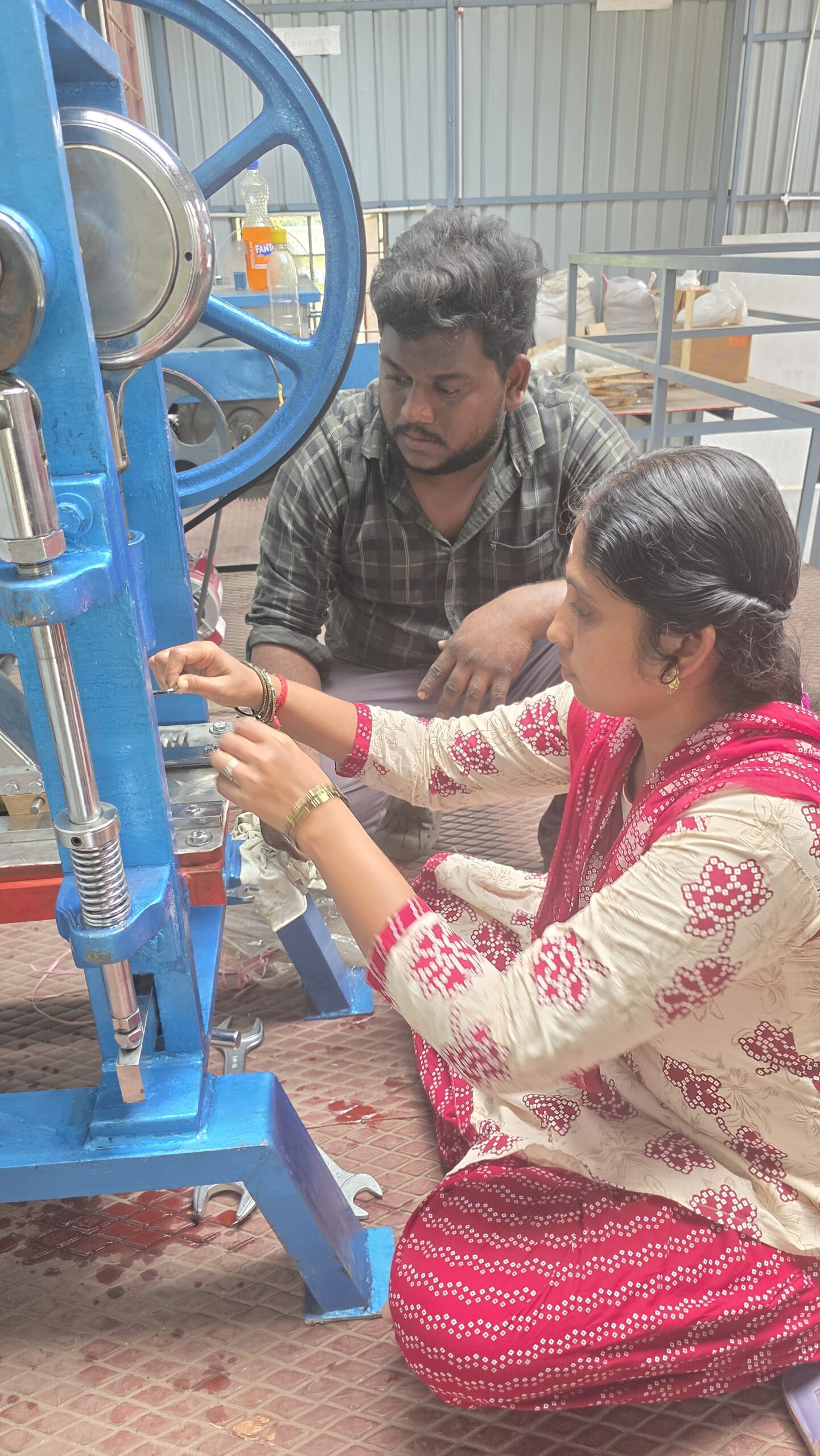
She showed up the next day ready. She told me she had gone through you-tube videos to see the machine operations.
Not dramatically transformed. Not suddenly fearless. But ready, prepared to take it on.
She called the paper-plate machine trainer. Clarified a few steps. Updated her notes. And began practice.
The first few attempts were cautious. The rhythm unsure. The pressure inconsistent.
I asked her, “Are you nervous today?”
She smiled, a little embarrassed. “It is overwhelming,” she admitted. “But just like I operate a mixer grinder at home, I will make this mine.”
That comparison stayed with me.
For fifteen years, she has managed a household with invisible precision — timing meals, multitasking chores. Yet we rarely call that skill. We call it “just being a housewife.”
But here she was — transferring the same instinct, the same muscle memory, the same steady focus — to a machine on a factory floor.
And in that moment, I did not see “another housewife.”
I saw a worker.
An economic contributor.
A woman reclaiming her own agency.
That book with Dr. Kalam’s face did not leave her side that first day.
Perhaps it was coincidence. Perhaps it was comfort. Perhaps it was the only note-book she had.
But to me, it was symbolism in its purest form.
A man who spoke about dreams.
A woman who had quietly postponed hers.
A training unit that would allow those dreams to re-enter the room.
Dr. Kalam once spoke of igniting minds. What I witnessed was the ignition of confidence.
Not loud. Not dramatic. Just a steady flame.
There is a misconception about empowerment. That it arrives like a grand announcement. That it needs applause. That it must be photographed and hashtagged.
In truth, it looks like this:
A woman asking if she can work after fifteen years.
A foundation saying yes.
Trainers patiently repeating instructions.
A notebook filling up with new information.
A hesitant hand pressing a machine switch for the first time.
A comparison between a mixer grinder and a manufacturing unit.
Organisations like Danirasa Foundation do not create talent. It already exists. They simply provide structure, support and a nudge.
A strong hand when needed.
A soft push when required.
Then space to soar.
Vasanthi is not an exception. She is a pattern waiting to be acknowledged.
Across our communities are women who paused their ambitions for family. Women who managed crises, households, caregiving, education — all unpaid, all unseen. When their season of caregiving lightens, society often offers them silence.
What if instead we offered opportunity?
What if we recognised that a fifteen-year “career break” is not a deficit but experience of another kind?
In that training unit, as camphor moulds formed, as wicks rolled, as incense was packed, as paper plates pressed into shape — something else was being manufactured.
Confidence.
Financial independence.
Dignity.
When I think back to that first morning — Vasanthi holding that book close, eyes scanning unfamiliar machinery — I realise the transformation did not happen in a dramatic instant.
It happened in small decisions.
She chose to step out.
She chose to learn.
She chose not to let nervousness win.
She chose to see a machine as just another appliance she could master.
And we chose to say, “You can.”
That is what enabling looks like.
Not charity.
Not sympathy.
But partnership.
Today, Vasanthi is practising. Learning. Calling trainers when needed. Updating notes. Showing up.
Fifteen years ago, she paused her own wings.
Today, she is testing them again.
And this time, she knows how to switch the machine on.